Executive Summary
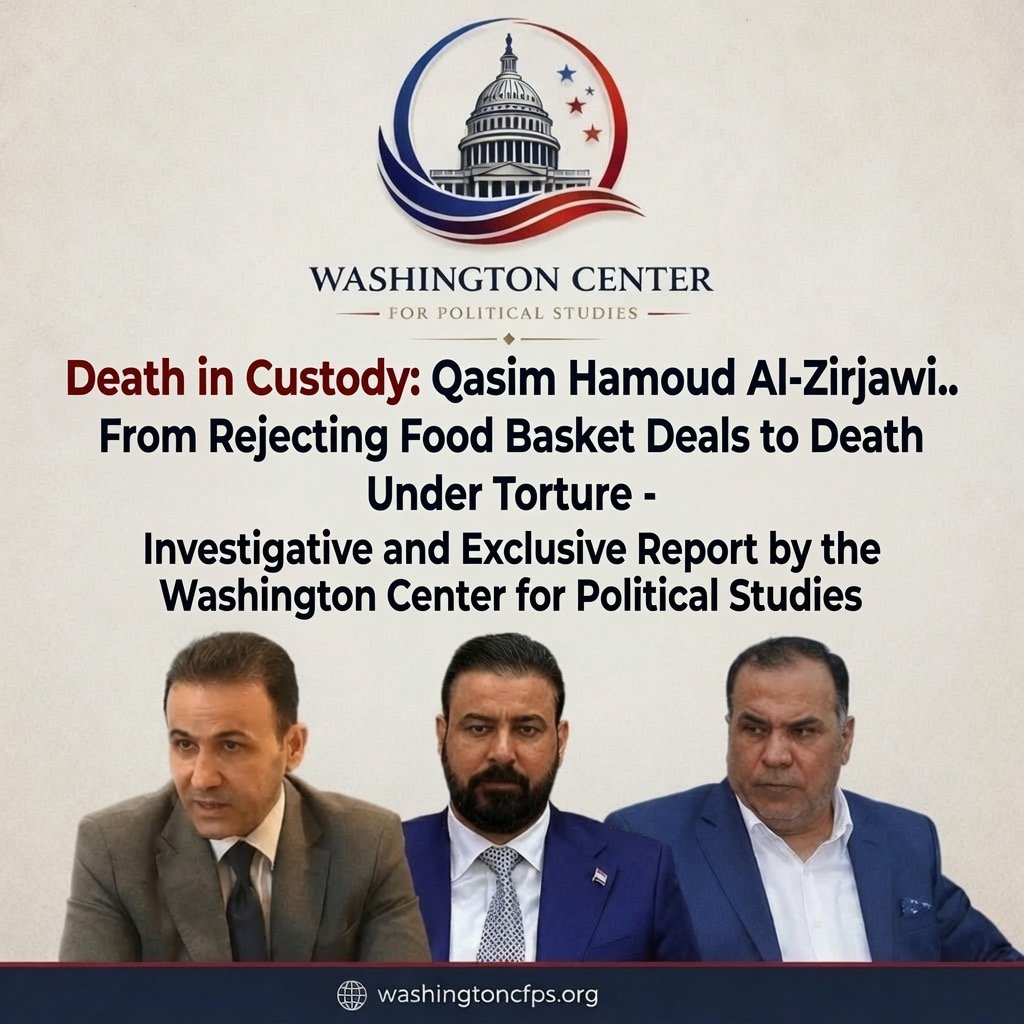
In August 2021, Engineer Qasim Hammoud Mansour Al-Zirjawi, Director General of the General Company for Trade in Foodstuffs at the Iraqi Ministry of Commerce, died after a few weeks of his arrest. His family and close sources confirm that he was subjected to brutal torture inside the detention cells, and the photos provided by the family show severe bruises all over the body and the loss of several teeth. A report published by The Washington Post in December 2022 documented serious violations in his case.
Since then, multiple narratives and testimonies have circulated indicating that Al-Zirjawi’s arrest was not due to corruption, but came as a result of his explicit refusal to approve suspicious deals in the food basket contracts (the ration card system), especially those related to the “Al-Aweis” company and transportation mechanisms. These narratives point to the involvement of a powerful influence network that includes the current Prime Minister Ali Falih Al-Zaidi and his brother Hassan Al-Zaidi, businessman Raed Al-Dhalimi, in addition to Judge Bashar and Judge Diya Jaafar.
Today, after Ali Al-Zaidi assumed the position of Prime Minister in May 2026 and announced the formation of a new anti-corruption committee headed by himself, the Al-Zirjawi case has become the first and most difficult test for this committee: Will the file be opened in a real and transparent manner, or will it be buried to protect the names associated with Al-Zaidi’s circle?
Background: The Man and the Institution
Qasim Hammoud Al-Zirjawi was known among his colleagues and former Ministers of Commerce for his extreme integrity and his repeated rejection of suspicious deals that generate huge profits for some influential figures. The food basket is considered one of the largest government spending files, and therefore the most vulnerable to corruption, which made Al-Zirjawi’s refusal a major obstacle to the interests of some networks.
Timeline of Events • May 9, 2021: Issuance of a ministerial order for Al-Zirjawi’s compulsory leave and the appointment of another person in his place. • July – August 2021: His arrest on corruption charges related to food basket contracts. • August 2021: His death in the hospital after about three weeks of detention, amid strong accusations of torture. • • 2022: The Washington Post report reveals part of the violations. • 2021-2026: Continued popular, tribal, and parliamentary demands to open an independent investigation.
Claims Regarding the Motives for Arrest and Death
Circulating narratives in media and tribal circles state that Al-Zirjawi refused to sign contracts for transporting food basket items with the “Al-Aweis” company because it was not the best technically or in price, and it served the interests of businessman Raed Al-Dhalimi, who is close to the Al-Zaidi family.
It is alleged that Hassan Al-Zaidi (the Prime Minister’s brother) exerted direct pressure on him, and with judicial assistance from Judge Bashar and Judge Diya Jaafar, he was replaced, then arrested and tortured. In recent years, new narratives have emerged linking the file more broadly to a political-economic-judicial influence network led by Ali Al-Zaidi and his circle.
Current Political Context and the New Committee
With Ali Falih Al-Zaidi’s announcement of the new anti-corruption committee that he personally heads, the Al-Zirjawi case has returned strongly to the forefront. The case has become a real test of the credibility of this committee.
If the committee is serious in its work, why has there been no announcement so far about opening the Al-Zirjawi file? And will the committee dare to summon Hassan Al-Zaidi and Raed Al-Dhalimi and question Judge Bashar and Judge Diya Jaafar? Or will the committee be a selective tool used only to settle political scores with opponents?
Demands and Responses • Al-Zirjawi’s family and tribe demand the immediate opening of the file and the accountability of all those involved, including Ali Al-Zaidi politically, Hassan Al-Zaidi, Raed Al-Dhalimi, Judge Bashar, and Judge Diya Jaafar. • Former and current MPs, in addition to activists and human rights organizations, demand an independent judicial investigation outside the control of Al-Zaidi’s committee. • So far, there is no official indication from the government or its new committee to reopen this file.
Analysis and Recommendations
1. The death of a senior official under torture in detention is a crime that does not expire with the statute of limitations, and it must be a priority for any genuine anti-corruption committee.
2. The Al-Zirjawi file is the first practical test for Al-Zaidi’s committee: either open the file with full transparency, or prove that the committee is merely political cover.
3. All documents and contracts of the food basket rejected by Al-Zirjawi will be published publicly.
4. Formation of a completely independent judicial investigation committee under the auspices of the Supreme Judicial Council and with the participation of international experts, far from the influence of Ali Al-Zaidi and his circle.
5. Ensuring the protection of witnesses and the family from any pressure or threats.
Conclusion
The case of Qasim Hammoud Al-Zirjawi is no longer just the story of the death of an honest employee, but has become the real criterion for the credibility of Ali Al-Zaidi and the anti-corruption committee he leads.
Either he opens the file and holds everyone accountable — even those closest to him — or he proves to the Iraqi people that fighting corruption in his era is nothing but a political slogan used to strengthen power and protect allies.
True justice requires transparency and accountability without exception.
An investigative journalistic investigation exclusively by the Washington Center for Political Studies in the US capital Washington, and the full investigation will be published in the coming days with all documents and evidence, including confessions from officers inside the infamous Abu Ragheef Committee who talk about the involvement of Ali Al-Zaidi and Abu Ragheef in the torture and killing of the Director General of the General Company for Trade in Foodstuffs, Qasim Hammoud Al-Zirjawi, inside the prison.