Executive Overview
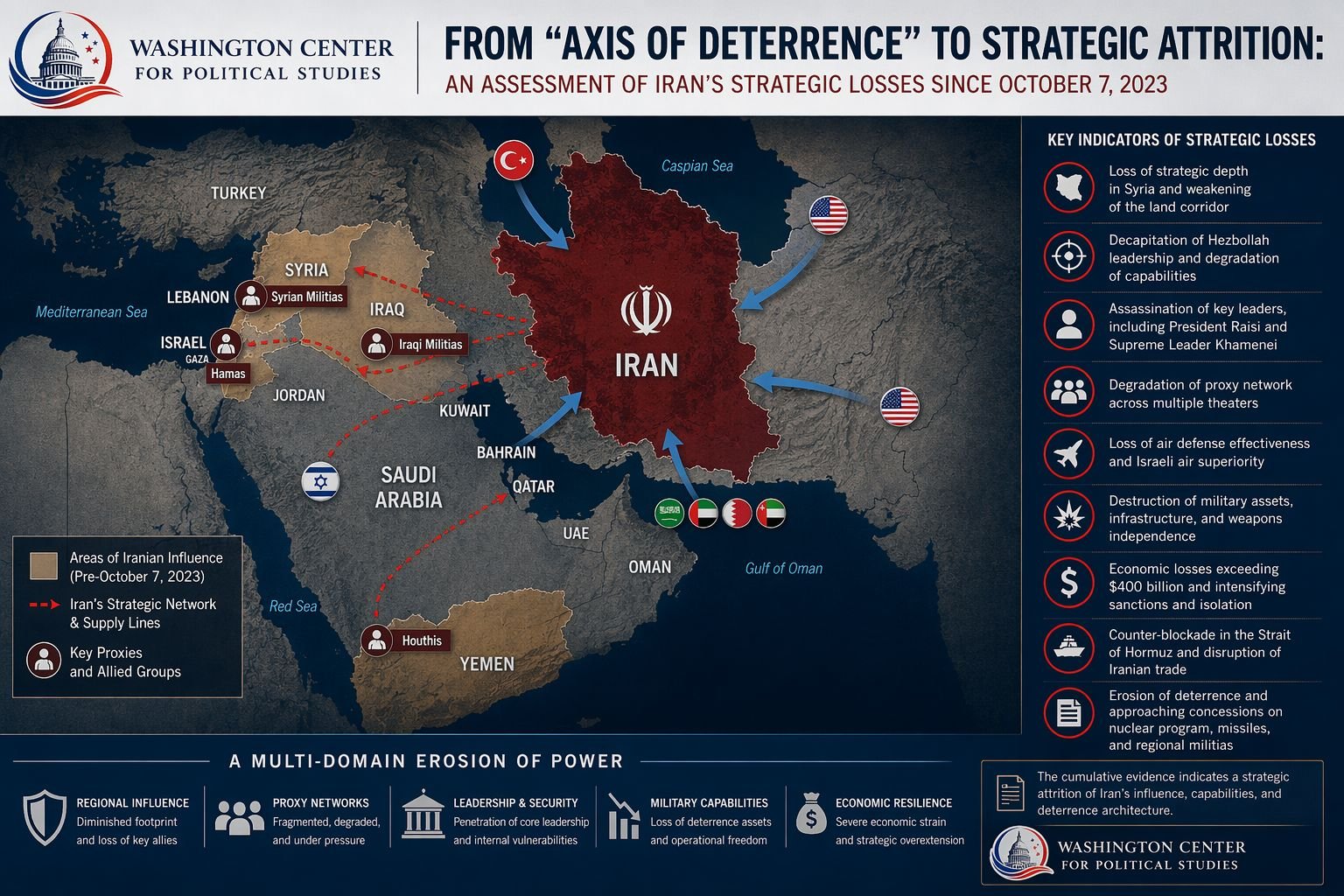
Since the events of October 7, 2023, Iran has sought to position itself as a primary strategic beneficiary of escalating regional dynamics, leveraging what it defines as the “Axis of Resistance” and its long-standing doctrine of “forward defense.” However, subsequent developments have increasingly demonstrated that this engagement has not translated into sustainable strategic gains. Instead, it has generated a pattern of cumulative losses affecting Iran’s regional influence, deterrence architecture, internal stability, and economic resilience.
This paper argues that Iran has not merely experienced isolated tactical setbacks, but rather a multi-layered strategic erosion across four interconnected domains: regional influence, proxy networks, leadership cohesion, and national sovereignty. Accordingly, narratives portraying Iran as emerging victorious from this phase are difficult to reconcile with observable shifts in the regional balance of power.
I. Erosion of Strategic Depth
Iran’s regional strategy has long relied on constructing a geopolitical corridor extending from Tehran through Baghdad and Damascus to Beirut. This network enabled logistical continuity, political leverage, and forward deployment capabilities. Recent developments, however, have exposed the fragility of this architecture under sustained military and political pressure.
The contraction—or, in some cases, expulsion—of Iranian-aligned factions from key arenas represents not merely a tactical setback but a structural weakening of Iran’s strategic depth. The significance lies not simply in territorial losses, but in the degradation of the enabling environment that underpinned Iran’s influence projection.
This shift underscores a critical reversal: proxy-based expansion, once a cost-efficient instrument of power, is increasingly becoming a liability as these networks are degraded, penetrated, or politically marginalized.
II. Hezbollah: From Strategic Asset to Strategic Liability
For decades, Hezbollah constituted Iran’s most valuable non-state asset in the Levant, serving as a cornerstone of its deterrence posture vis-à-vis Israel. However, sustained targeting of Hezbollah’s leadership, infrastructure, and operational networks has significantly diminished its strategic utility.
High-profile security breaches and targeted assassinations have exposed vulnerabilities within the organization’s command structure. Simultaneously, intensified military engagement in southern Lebanon has transformed the Lebanese front from a deterrent platform into a theater of attrition.
The broader implication is clear: Iran’s most critical forward deterrent is no longer operating from a position of strength. Even if Hezbollah retains residual military capabilities, its effectiveness as a credible strategic deterrent has been substantially weakened.
III. Leadership Targeting and Exposure of the Decision-Making Core
Perhaps the most consequential development has been the shift from targeting peripheral actors to striking at the core of Iran’s leadership structure. The death of President Ebrahim Raisi in 2024 marked an early shock to the system’s internal stability. More significantly, the reported targeting of senior leadership figures, including the Supreme Leader, reflects an unprecedented breach of Iran’s highest security layers.
Regardless of interpretation, the targeting of top leadership signals a profound shift in the nature of the conflict—from indirect confrontation to direct strategic penetration.
This development fundamentally alters Iran’s national security calculus. A state that built its doctrine on insulating the homeland from conflict is now compelled to prioritize internal protection, thereby constraining its external maneuverability.
IV. Degradation of the Proxy Network
Beyond Lebanon, Iran’s broader network of allied actors has faced significant disruption. In Yemen, the targeting of senior Houthi leadership has raised serious questions about the resilience of Iran’s southern axis. Similarly, repeated assassinations of figures affiliated with Hamas and other groups indicate a systematic effort to dismantle the leadership tiers of Iran-aligned organizations.
Collectively, these developments point to a pattern of decapitation strategy applied across multiple theaters. The result is not only operational disruption, but also weakened coordination, cohesion, and strategic alignment within the broader network.
As a consequence, what was once a relatively coherent axis now appears increasingly fragmented, reactive, and heavily dependent on Tehran at a time when Tehran itself is under mounting pressure.
V. From Deterrence to Strategic Vulnerability
Iran’s military doctrine has historically emphasized asymmetry, proxy warfare, and the avoidance of direct large-scale confrontation. However, recent developments indicate a shift toward direct exposure.
Strikes on military installations, critical infrastructure, and sensitive sites within Iranian territory—combined with indications of reduced effectiveness in air defense systems—highlight a growing vulnerability: the erosion of territorial inviolability.
The weakening of airspace control represents a strategic inflection point. In classical deterrence theory, the ability to protect national territory is a fundamental component of state power. Its degradation reshapes adversaries’ calculations regarding risk and escalation.
VI. Economic Pressure and Strategic Overextension
The economic dimension of the conflict further compounds Iran’s strategic challenges. Disruptions to maritime trade, particularly in the Strait of Hormuz, alongside countermeasures targeting Iranian exports, have intensified pressure on an already strained economy.
While the militarization of critical chokepoints can serve as a coercive tool, it simultaneously exposes Iran to reciprocal containment. In this context, economic instruments of pressure function as double-edged tools, imposing significant costs on both adversaries and Iran itself.
The broader outcome is a deepening cycle of economic attrition, limiting Tehran’s capacity to sustain prolonged regional engagement.
VII. Collapse of the Strategic Narrative
Beyond material losses, Iran faces a more intangible but equally critical setback: the erosion of its strategic narrative.
For years, Tehran advanced three core assumptions:
1. That its forward defense doctrine would keep conflict away from Iranian territory
2. That its proxy network would function as a protective shield
3. That its deterrence posture would prevent direct targeting
Recent developments have undermined all three. Conflict has extended into Iranian territory, proxies have become targets rather than shields, and deterrence has failed to prevent high-level targeting.
The weakening of this narrative carries significant domestic and regional implications, as it challenges the credibility of the strategic model itself.
VIII. Residual Capabilities and Strategic Outlook
Despite these setbacks, Iran retains important capabilities, including missile systems, asymmetric warfare expertise, and a network—albeit weakened—of regional relationships. These assets ensure that Iran remains a consequential regional actor capable of imposing costs on its adversaries.
However, the nature of these capabilities has shifted. They now function less as tools of expansion and more as mechanisms for preventing total strategic defeat.
Any future negotiations—particularly regarding the nuclear program, missile capabilities, or regional militias—are likely to reflect this altered balance, with Iran operating from a more constrained strategic position.
Conclusion
The cumulative evidence suggests that, since October 7, 2023, Iran has not achieved a strategic victory in conventional analytical terms. Instead, it has experienced a progressive erosion of power across multiple domains: diminished regional influence, weakened proxy networks, leadership vulnerability, increased internal exposure, and mounting economic pressure.
In analytical terms, the issue is no longer whether Iran has incurred losses, but rather the extent to which it can reconstruct its deterrence architecture and restore its regional influence following this period of sustained attrition.