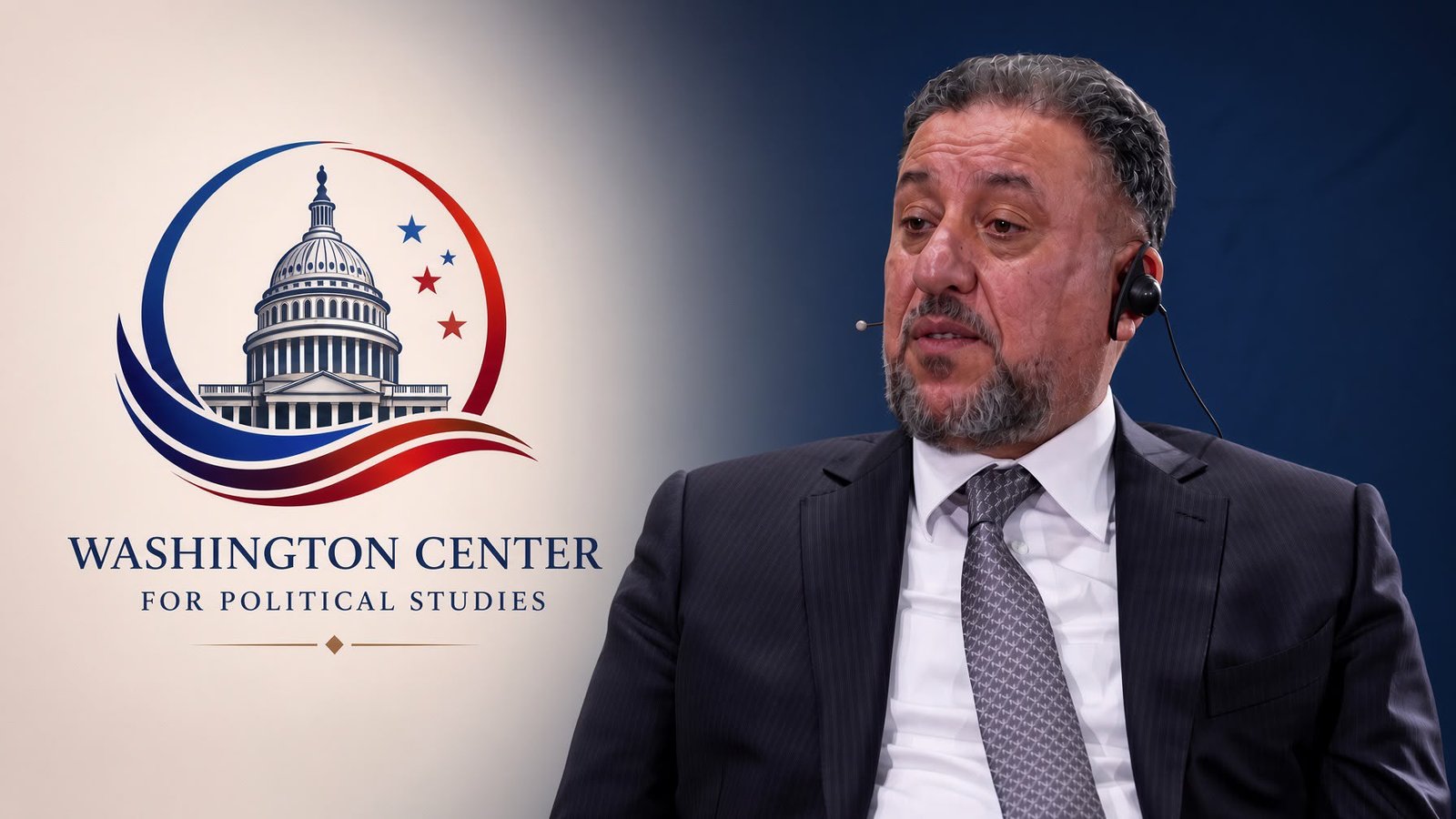
In a country like Iraq, which has endured successive political, security, and sectarian crises over the past two decades, a politician’s success cannot be measured solely by the number of seats he obtains, the positions he seizes, or the alliances he forms; but rather by his ability to manage disagreement, absorb crises, maintain bridges of communication with those who differ from him, and transform political influence from a means of confrontation into a tool for negotiation and the achievement of interests.
From this angle, an important aspect of the experience of the Iraqi politician Khamis al-Khanjar can be read; he is among the figures who have managed to maintain their presence on the Iraqi scene despite the major transformations the country has witnessed, and to move from social and humanitarian work to political work, ultimately leading the Sovereignty Alliance and playing an influential role in the Sunni and national political equation.
Although his experience, like that of all influential political figures, is not free from controversy and criticism, a number of his positions in recent years reveal an approach inclined toward political moderation, dialogue, avoidance of rupture, and the search for possible settlements.
From Humanitarian Work to Political Work
Khamis al-Khanjar’s presence did not begin from a governmental position or an official post; rather, his political activity was preceded by a social and humanitarian presence.
Press sources indicate that he founded a social care institution in 2005 that provided assistance to the wounded, the sick, and those with limited incomes, and contributed to treating some cases outside Iraq and providing educational and housing assistance. He has also been credited with establishing schools and clinics to serve Iraqi displaced persons in the Kurdistan Region during the years of the war against ISIS.
This background is important when reading his experience, because it means that his relationship with society did not begin at the ballot box, but rather preceded his direct entry into political competition.
Moderation as a Political Choice
The most notable observation in al-Khanjar’s discourse in recent years is his attempt to deal with political disagreement as a matter that can be managed, rather than a battle that must end with the victory of one side and the downfall of the other.
This is an important matter in Iraq, where many political disagreements have turned into crises between components, and competition over positions has at certain stages become a cause of paralyzing state institutions.
When disagreement escalated among Sunni forces over the speakership of the Council of Representatives, al-Khanjar described what was happening as a difference of viewpoints rather than a conflict, and considered that the disagreement of parties and political blocs regarding candidates is natural.
More importantly, he linked the stability of the Sunni component to the stability of the other components, in a vision based on the interconnected stability of Sunnis, Shiites, and Kurds, and that disturbance in any side is reflected on Iraq as a whole.
This idea represents the essence of political moderation: to defend your constituency without building its strength on the weakening of others.
Dialogue Instead of Breaking Wills
In Iraqi politics, a politician can easily raise the ceiling of his discourse, but the more difficult thing is to know when to lower the level of tension and seek a settlement.
Here one of the strengths of al-Khanjar’s approach appears.
He has been keen at various junctures to keep his relations open with Sunni, Shiite, and Kurdish political forces, even when there were real disagreements with them.
This does not mean the absence of a position, but rather means separating political disagreement from political enmity.
In a democracy, an opponent may be your competitor today and your partner tomorrow, and a complex state like Iraq cannot be managed by the logic of permanently closing doors to those who differ.
Kirkuk.. De-escalation at a Sensitive Moment
Among the positions that deserve attention is what al-Khanjar spoke about regarding the Kirkuk crisis of 2023.
In the midst of a state of political and security tension in the city, al-Khanjar said that he went to Kirkuk and met with representatives of Arabs, Turkmen, and Kurds, in addition to officials and security leaders, in an attempt to lower the level of escalation.
According to his published account, those meetings contributed to de-escalation, stopping the tension, and canceling moves that were feared would lead to further polarization.
Regardless of the size of the role each side attributes to itself in containing that crisis, the political principle here is important:
When an Iraqi city is on the brink of confrontation, the politician’s responsibility is not to invest in the anger of the street, but rather to prevent confrontation before it occurs.
Leadership is not always in escalation; sometimes the bravest decision is the decision to de-escalate.
His Relationship with the Kurds.. Difference Does Not Mean Rupture
The politics of dialogue appears more clearly in al-Khanjar’s relationship with Kurdish political forces.
He has maintained channels of communication with leaders of the Kurdistan Region at various stages, and discussed with them thorny files related to Kirkuk, the budget, and the relationship between Baghdad and Erbil.
He has also focused in his speeches on the importance of coexistence and respect for Iraqi diversity, and on the principle that national or political difference should not turn into a cause of division.
This vision is important because Iraq cannot be managed by the logic of a single component.
Iraq is a multi-national, multi-religious, and multi-sectarian state, and any political project that wants to succeed at the national level must acknowledge this fact and deal with it as part of Iraq’s strength rather than a permanent cause of conflict.
Iraq’s Unity Is a Red Line
Among the notable positions is also al-Khanjar’s stance on projects to form regions on a sectarian basis.
Although the Iraqi constitution allows the formation of regions according to specific mechanisms, al-Khanjar declared that Iraq’s unity is a red line, and expressed his rejection of the idea of establishing regions based on a sectarian foundation because of the risks they could pose to the country’s unity.
Here the difference appears between defending the rights of a component and transforming those rights into a separatist project.
A politician has the right to defend his provinces and his constituency, but a statesman is one who can defend those rights within the framework of Iraq, not at the expense of its unity.
The State Above the Weapon
Among the fundamental issues in al-Khanjar’s discourse is his position on the militarization of society and the spread of weapons outside the natural framework of the state.
He has spoken of the necessity of ending the militarization of cities, and linked stability to the existence of strong state institutions capable of enforcing the law and protecting citizens.
He has also placed the problem of uncontrolled weapons among the issues that require genuine political solutions.
This position is consistent with the concept of the modern state, where a stable state cannot be built if centers of security and military decision-making are multiplied within it.
The state that Iraq needs is not a state that is strong against the citizen and weak before the armed forces, but rather a state in which the law is the supreme reference for all.
The Displaced and Jurf al-Sakhar.. Rights That Should Not Be Lost
The file of the displaced and the areas to which their people have not returned after the war against ISIS is one of the most present files in Khamis al-Khanjar’s discourse.
He has repeatedly spoken about the return of the displaced, especially the people of Jurf al-Sakhar, and linked the issue to citizens’ right to return to their homes and lands.
He has also sought to include the files of the displaced, general amnesty, balance, and the rights of affected provinces within political agreements and negotiations.
What is noteworthy here is that the handling of these files has mostly come through political demand and negotiation, rather than through a vengeful discourse against other components.
The displaced Iraqi, regardless of his sect or nationality, is a citizen with a right in the state, and the outcomes of wars should not turn into collective punishments that extend for long years.
Al-Khanjar and al-Halbousi.. A Difference in Approach
When comparing Khamis al-Khanjar with Mohammed al-Halbousi, a difference appears in the style of managing politics and disagreements.
Al-Halbousi possesses an electoral and party weight that cannot be denied, and has succeeded in building an influential political organization, but al-Khanjar appears at a number of junctures more inclined toward calm, flexibility, and maintaining lines of communication, especially in his relations with Shiite and Kurdish forces and in the way he deals with disagreements within the Sunni house.
Al-Khanjar himself described his disagreement with al-Halbousi as a difference in “approach and path,” a phrase that summarizes an important aspect of the relationship between the two men.
Al-Khanjar, even when competition intensified, kept the possibility of dialogue open, and this later appeared when he moved to contribute to ending the disagreement between al-Halbousi and Nechirvan Barzani and opening a new page of political cooperation.
From this angle, it can be said that al-Khanjar’s positions on a number of files appeared more moderate and calm, because he tends to build balances and reopen doors of dialogue rather than transforming competition into permanent rupture.
This does not detract from al-Halbousi’s political or electoral weight, but it reveals a difference in the way of practicing politics.
Political success is not measured only by the number of seats, but also by the ability to manage disagreement and prevent it from turning into a crisis.
Here one of al-Khanjar’s strengths appears: the inclination to build bridges when relations between parties become more complicated, and to view dialogue as a tool of strength rather than a sign of weakness.
Settlements Instead of Confrontation in Diyala
In the Diyala file as well, this approach appeared when the province entered a political crisis related to the formation of the local government.
Instead of presenting the crisis as an open confrontation between components, al-Khanjar spoke of multiple scenarios for a solution and of the necessity of reaching a shared vision among the parties.
This is a political method particularly needed by mixed provinces.
In areas such as Diyala and Kirkuk, one side cannot feel that it has won definitively while the other side feels that it has been definitively defeated.
Genuine stability requires a balance in which everyone feels that they are part of the administration and the decision.
Respect for Political Agreements
Among the important points in al-Khanjar’s discourse is also his emphasis on implementing the political agreements on the basis of which governments are formed.
One of the causes of the crisis of trust in Iraq is that many agreements are concluded during negotiations to form governments, then ignored after the distribution of positions.
Al-Khanjar has stressed on more than one occasion the importance of implementing the political agreement and the commitments approved by the forces participating in the formation of the government.
This is a matter that goes beyond partisan interests.
The state cannot stabilize if agreements become mere papers used to obtain positions and then neglected.
Political trust is built when each party knows that the agreement it signs today will remain respected tomorrow.
Iraq and Its Foreign Relations
At the level of foreign relations, al-Khanjar’s vision appears closer to political pragmatism.
He has supported dialogue between Iraq and its international partners, and spoken of the importance of security cooperation and the exchange of expertise and information in a manner that serves the interests of the Iraqi state.
This approach is important given Iraq’s complex geographic and political location.
Iraq does not need to turn into an arena for conflict between international and regional powers; rather, it needs to build balanced relations with its Arab surroundings, Iran, Turkey, the United States, and the rest of the international community on the basis of its national interest.
Successful foreign policy is not choosing a permanent enemy or a permanent ally, but rather knowing where Iraq’s interest lies.
The Political Competitor Is Not an Enemy
Among the important features of al-Khanjar’s political personality is his ability to return to dialogue even after disagreements.
The Sunni scene has witnessed sharp competition among different political forces over the past years, but al-Khanjar has maintained at multiple stages the possibility of communicating with them.
After the elections, he called on Sunni forces to meet and develop a shared vision for the next political phase.
This type of behavior reflects an important understanding of democracy:
The electoral competitor is not an enemy.
You can differ with him today, run against him in elections tomorrow, then sit with him afterward when the country’s interest requires reaching an agreement.
Quiet Politics Is Not Weakness
Perhaps this point is the most important when evaluating the experience of Khamis al-Khanjar.
Political moderation is often understood in our region in a mistaken way, as if it were weakness or hesitation.
But the truth is that controlling discourse in times of crisis is sometimes more difficult than launching fiery statements.
The moderate politician is not the politician who has no position.
Rather, he is the politician who has a position, but knows how to achieve a large part of it at the lowest possible cost to the state and society.
To be strong does not mean to be confrontational.
To negotiate does not mean that you have conceded.
To respect your opponent does not mean that you agree with him.
This political culture is what Iraq needs after more than two decades of conflicts.
From Component Leadership to Statesman
The real challenge facing Khamis al-Khanjar in the coming phase is to move more fully from a political leadership linked to a particular constituency and areas to a national project capable of addressing all Iraqis.
A politician can succeed within his component, but a statesman is one who can make the citizen in Basra, like the citizen in Anbar, and the citizen in Erbil, like the citizen in Baghdad, see in his discourse something of his interests.
The premises exist in al-Khanjar’s discourse: Iraq’s unity, dialogue with the Kurds and Shiites, defense of state institutions, rejection of the militarization of society, addressing the displaced persons file, respect for political agreements, and the search for settlements.
But the challenge remains in transforming these positions into a complete and sustainable political project.
Conclusion
Iraqis may differ over Khamis al-Khanjar, and this is natural in evaluating any influential political figure.
But fairness requires that a politician’s experience not be read only through his rivalries or alliances, but through his positions and the way he manages crises.
When we look at an important aspect of al-Khanjar’s experience, we find a politician inclined toward dialogue rather than rupture, balance rather than dominance, and de-escalation rather than investing in crises.
He defended the return of the displaced, raised the issue of Jurf al-Sakhar, spoke of ending the militarization of cities, affirmed Iraq’s unity, maintained relations with Kurdish and Shiite forces, sought settlements within the Sunni house, and kept the doors of dialogue open even with his competitors.
These positions do not mean that his experience is without errors, but they reveal a political philosophy that Iraq needs.
Iraq does not suffer from a shortage of politicians who know how to start a disagreement.
What Iraq truly needs is the politician who knows how to end it.
It does not need someone who proves that he is the strongest among the components, but rather someone who can bring these components together when they drift apart.
It does not need a leader who turns every opponent into an enemy, but rather a political man who knows that today’s opponent may be tomorrow’s partner in building the state.
From here the value of moderation in the experience of Khamis al-Khanjar stands out.
Politics is not the art of breaking opponents, but the art of preventing disagreement from breaking the homeland.
And if al-Khanjar can maintain this approach and develop it into a broader national project, his political value will not be measured by the number of seats or positions, but by his ability to contribute to building a more stable and balanced Iraq.